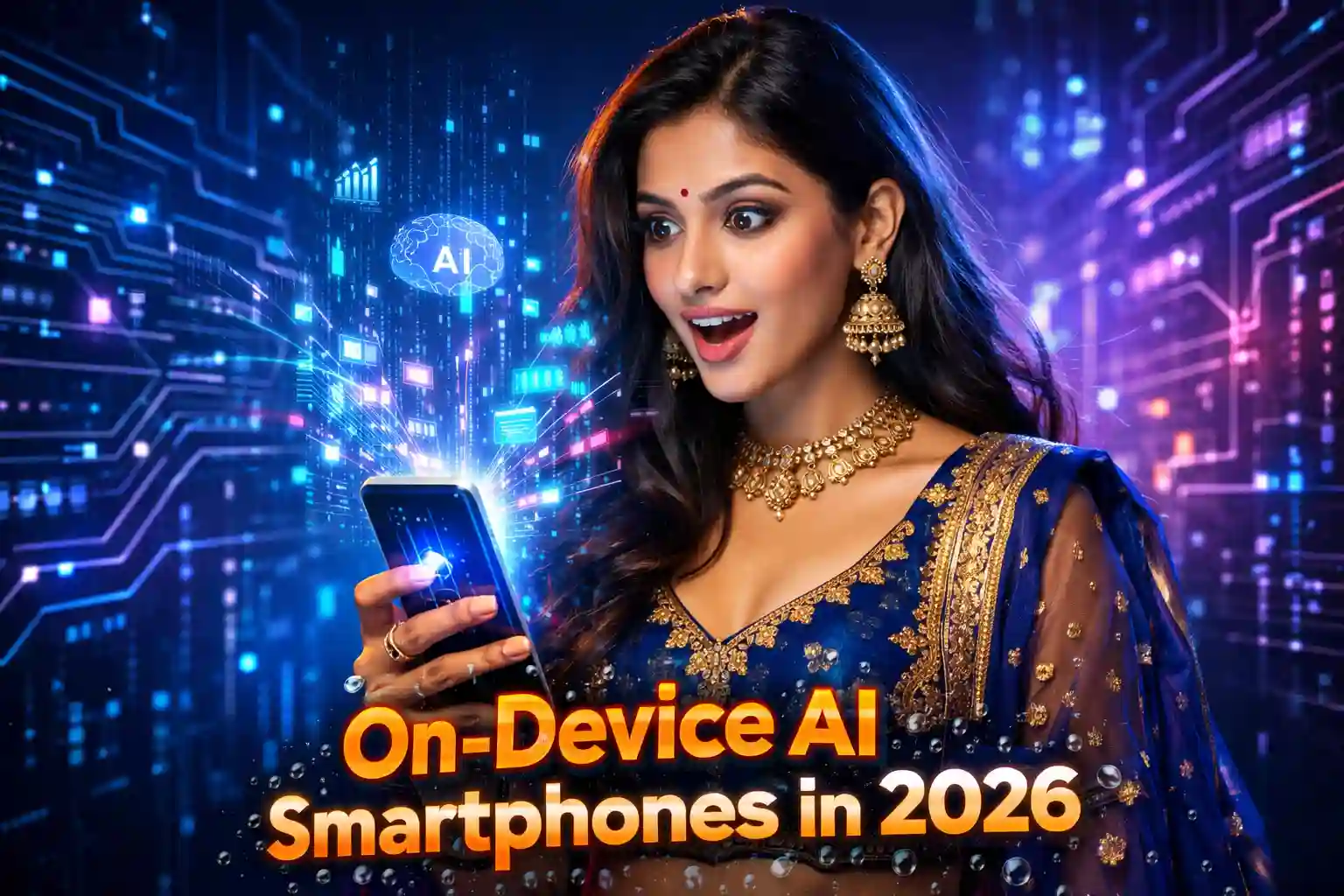
On-device AI smartphones are completely transforming the way we use mobile technology in 2026. Unlike traditional cloud-based AI, on-device AI runs directly on your phone’s chip — delivering instant results, stronger privacy, and full offline functionality. If you have been wondering what all the buzz around Edge AI and on-device AI is about, this complete guide explains everything in simple terms.
In this guide, we break down exactly what on-device AI means, how Edge AI works on your smartphone, which phones lead the pack in 2026, and why this matters for your daily life.

What Is On-Device AI? The Best Explanation for Smartphone Users
On-device AI refers to artificial intelligence that runs directly on your phone’s processor — not on a remote server. When you use an on-device AI smartphone, tasks like photo editing, voice recognition, and smart suggestions all happen instantly on the chip inside your device. No data is sent to the cloud. No internet is needed.
Traditionally, when you asked your assistant a question or applied a photo filter, your phone sent that request to a cloud server, which processed it and sent back a result. This takes time and uses your data. On-device AI smartphones eliminate that delay entirely.
This is made possible by a special chip inside modern phones called a Neural Processing Unit (NPU) — a processor designed specifically for AI and machine learning tasks. Brands like Qualcomm, Apple, Google, and Samsung have been building increasingly powerful NPUs since 2020, and in 2026, they have become the primary battleground for smartphone performance.
What Is Edge AI on Smartphones and How Is It Different From Cloud AI?
Edge AI on smartphones is the broader term for AI that runs at the “edge” of a network — meaning on the device itself rather than in a central data center. Your smartphone is a classic example of an edge device. Understanding the difference between cloud AI and on-device AI smartphones is key to appreciating why this shift matters.
| Feature | Cloud AI | Edge AI (On-Device AI Smartphones) |
|---|---|---|
| Processing Location | Remote server | Your phone’s chip |
| Speed | Slower (depends on internet) | Instant (no network needed) |
| Privacy | Data sent to server | Data stays on device |
| Works Offline | No | Yes |
| Battery Impact | Lower (offloads work) | Efficient with modern NPUs |
As NPU chips become more efficient in 2026, the battery gap between cloud and on-device AI is rapidly closing — making on-device AI smartphones the clear winner for everyday use.
How On-Device AI Actually Works on Your Smartphone in 2026
When you take a photo on an on-device AI smartphone, the camera app does not just capture light. The NPU is constantly working in the background to:

- Detect what is in the frame (person, landscape, food, night scene)
- Adjust ISO, shutter speed, and HDR settings in real time
- Remove noise and enhance detail after the shot
- Suggest edits — all offline and instantly
Similarly, when you use voice commands, your on-device AI smartphone no longer needs to ping Google or Apple’s servers for basic tasks. The AI model runs locally. This is why modern voice assistants feel faster and more responsive than ever before.
Other real-world examples of on-device AI at work in your phone right now:
- Smart Reply — Suggesting text replies based on context
- Live Translate — Translating conversations in real time without Wi-Fi
- Face Unlock — Secure facial recognition processed on-chip
- Adaptive Battery — Learning your usage patterns to save power
- Real-Time Transcription — Converting speech to text offline
Best On-Device AI Smartphones in 2026: Top Picks Revealed
Not all phones handle on-device AI equally. Here are the top on-device AI smartphones leading the edge AI revolution in 2026:
1. Samsung Galaxy S26 Ultra — Best On-Device AI Smartphone Overall
Powered by the Snapdragon 8 Gen 4 (or Exynos 2600 in some regions), the S26 Ultra runs Samsung’s Galaxy AI suite entirely on-device. This on-device AI smartphone handles Live Translate, Circle to Search, and the AI-powered Privacy Display all through local processing. Check out our guide to the best Samsung Galaxy phones for a full comparison.
2. Google Pixel 9 Pro — Best On-Device AI Smartphone for Privacy
Google’s Tensor G5 chip is built from the ground up for on-device AI on smartphones. The Pixel 9 Pro handles tasks like Call Screen, Live Caption, and Magic Eraser entirely offline. According to Google AI, the Tensor G5 delivers 2x better on-device inference than its predecessor.
3. Apple iPhone 17 Pro — Most Powerful On-Device AI Chip
Apple’s A19 Bionic chip includes a 16-core Neural Engine capable of running large language models locally. Apple Intelligence handles writing tools, smart summaries, and image creation without ever leaving your device. Learn more at Apple’s official Intelligence page.
4. OnePlus 13 Pro — Best Value On-Device AI Smartphone
Running on Snapdragon 8 Gen 4, the OnePlus 13 Pro delivers flagship-tier on-device AI at a more competitive price point. See our best Android phones under ₹50,000 post for budget-friendly alternatives.
5. Xiaomi 15 Ultra — Best On-Device AI Camera Smartphone
Xiaomi’s partnership with Leica and its HyperOS AI layer makes the 15 Ultra one of the most capable AI photography phones available. Its on-device AI processing engine handles computational photography at a level that rivals dedicated cameras. Read the full specs at GSMArena’s Xiaomi 15 Ultra page.
5 Brilliant Benefits of On-Device AI Smartphones You Should Know
- Faster Performance — No round-trip to a server means instant results. On-device AI smartphones respond in milliseconds.
- Better Privacy — Your photos, voice, and messages never leave your device. This is especially important for banking apps and sensitive communications.
- Offline Functionality — AI features on on-device AI smartphones work even without an internet connection. Perfect for travel or poor signal areas.
- Lower Data Costs — Since processing is local, you use less mobile data for AI-powered tasks.
- Improved Personalization — Your phone learns your habits locally, giving you smarter suggestions without a company storing your behavior profile.
On-Device AI Smartphones and Privacy: Why It Matters Most in 2026
One of the biggest concerns with AI is data privacy. When AI runs in the cloud, your data — your voice, your face, your location — is processed on third-party servers. On-device AI smartphones fundamentally change this equation. When your phone processes everything locally, you remain in control.
This aligns with global privacy regulations like GDPR in Europe and is driving a shift in how tech companies design AI features. According to Qualcomm’s AI research, on-device AI eliminates the need to transfer sensitive user data to external servers.
If you are concerned about your phone’s security settings, read our guide on how to secure your Android phone in 2026 for practical tips.
The Exciting Future of On-Device AI Smartphones Beyond 2026
The trajectory of on-device AI smartphones is pointing toward devices that can run full large language models (LLMs) locally. In 2026, we are already seeing early versions of this — Google’s Gemini Nano runs on Pixel devices without any cloud connection. Apple Intelligence runs writing and image tools entirely on-device.
Other upcoming developments in on-device AI smartphones to watch:
- AI-powered health monitoring — Real-time analysis of heart rate, sleep, and stress data
- On-device language learning — Apps that adapt to your level without cloud servers
- AI coding assistants on phones — Writing and debugging code directly on mobile
- Autonomous AI agents — Phones that complete tasks like booking or shopping on your behalf
Should You Upgrade to an On-Device AI Smartphone in 2026?
If your phone is more than 3 years old, chances are it is missing out on most on-device AI smartphone features. Newer chipsets like Snapdragon 8 Gen 3 and above, Apple A17 and above, and Google Tensor G4 and above are required to run most 2026-era AI features smoothly.
However, upgrading purely for AI is not necessary for everyone. If you rely on productivity apps, translation, photography, or privacy-sensitive work, an on-device AI smartphone with a strong NPU will make a noticeable difference. Check our full guide on best devices for students in 2026 if you are looking for a productivity-focused upgrade.
Frequently Asked Questions About On-Device AI Smartphones
What is on-device AI in smartphones?
On-device AI smartphones use artificial intelligence that processes data directly on the phone’s chip (NPU) without sending information to external servers. This results in faster, more private, and offline-capable AI features.
Which phones have the best on-device AI in 2026?
The top on-device AI smartphones in 2026 include Samsung Galaxy S26 Ultra, Google Pixel 9 Pro, Apple iPhone 17 Pro, OnePlus 13 Pro, and Xiaomi 15 Ultra. All run powerful Neural Processing Units (NPUs) that handle AI tasks locally.
Is Edge AI the same as on-device AI?
Yes, essentially. Edge AI is the broader concept of running AI at the “edge” of a network, and on-device AI smartphones are the specific application of this technology on mobile devices.
Does on-device AI drain battery faster?
Modern NPU chips in on-device AI smartphones are highly power-efficient. Flagship phones in 2026 handle AI tasks with minimal additional battery drain thanks to dedicated low-power AI cores.
Can on-device AI work without the internet?
Yes — this is one of the biggest advantages of on-device AI smartphones. Features like live translation, voice commands, photo editing, and real-time transcription all work completely offline.
Conclusion
On-device AI smartphones are not just a trend — they represent a fundamental and exciting shift in how mobile technology works. In 2026, your phone is smarter, faster, more private, and more capable than ever — all because AI has moved from distant data centers to the chip in your pocket.
Whether you are a casual user who loves a great camera or a professional who needs privacy-first tools, on-device AI smartphones have something valuable to offer. As chipmakers continue to push the boundaries of what NPUs can do, the gap between your phone and a full AI computer will shrink until there is no difference at all.
Stay updated with the latest mobile technology news on PGUpdate.in — your trusted source for tech guides, phone reviews, and Windows fixes.
Found this article helpful? Share it with someone upgrading their phone in 2026!