12 Over 12 Windows: The Complete Guide
If you’ve ever admired the stately facade of a Georgian Colonial home and found yourself mesmerised by those beautifully proportioned windows — divided into a precise, rhythmic grid of small glass panes — you’ve already seen 12 over 12 windows in their most natural habitat. These architectural icons, born out of necessity in 17th-century America, have endured for over three hundred years and remain one of the most debated and desired window styles in residential design today.
Whether you’re restoring a historic Colonial home, building a new house with traditional character, or simply trying to understand what your architect means when they reference a “12/12 window configuration“, this comprehensive guide has everything you need. We’ll cover the history, the anatomy, the pros and cons, how they compare to 6-over-6 and 9-over-9 styles, cost breakdown, energy efficiency in modern applications, and expert installation advice.

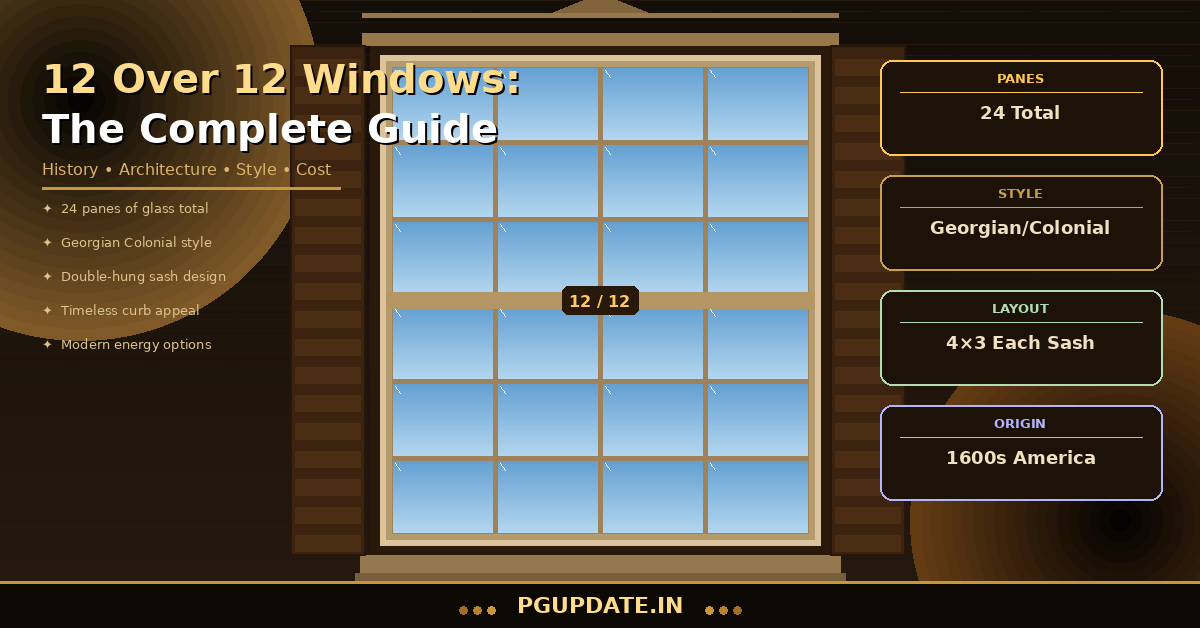
Quick Answer: A 12 over 12 window (written as 12/12 or 12-over-12) is a double-hung window featuring 12 individual glass panes in the upper sash and 12 panes in the lower sash — 24 panes of glass in total. The panes are separated by thin strips of wood or metal called muntins. This configuration is most strongly associated with Georgian Colonial architecture from 17th–19th century America.
📋 Table of Contents

- What Are 12 Over 12 Windows?
- The History: How Colonial Architecture Gave Birth to 12/12 Windows
- Anatomy of a 12 Over 12 Window
- 12/12 vs 9/9 vs 6/6 — Which Is Right for Your Home?
- What Home Styles Suit 12 Over 12 Windows Best?
- Are 12 Over 12 Windows Energy Efficient in 2026?
- Materials & Frame Options for 12/12 Windows
- 12 Over 12 Window Cost Breakdown
- Installation Guide: What to Know Before You Buy
- Maintenance Tips for 12 Over 12 Windows
- Where to Buy 12 Over 12 Windows in 2026
- Frequently Asked Questions
- Final Verdict
What Are 12 Over 12 Windows?
12 over 12 windows are a specific configuration of double-hung windows in which each sash — both the upper and lower moving panels — contains 12 individual glass panes, arranged in a grid pattern. Most commonly, these panes are arranged in 4 columns by 3 rows in each sash, creating a uniform, symmetrical grid across the entire window face. With both sashes combined, you get a total of 24 panes of glass in a single window unit.
The term “over” in window notation refers to the sash configuration. When you read “12 over 12,” it simply means 12 lites (individual panes) in the upper sash, positioned over 12 lites in the lower sash. This same naming convention applies to other popular configurations such as 6-over-6 (the most common Colonial window today) and 9-over-9 (a mid-range option often seen in Georgian revival homes).

The thin strips of wood or metal that separate the individual glass panes are called muntins (sometimes also referred to as glazing bars, grilles, or grids). In original 17th and 18th century windows, these muntins were structural — they held together small panes of hand-blown glass because large sheets of glass were prohibitively expensive and technically difficult to produce. In modern reproductions, muntins are primarily decorative, simulating the look of divided-light windows while using single, large panes of contemporary insulated glass behind them.
The History: How Colonial Architecture Gave Birth to 12/12 Windows
To understand why 12 over 12 windows exist, you need to step back into 17th-century colonial America. When the first European settlers arrived in the New World, they brought with them the architectural traditions of their home countries — primarily England, Holland, France, and Spain. Among the most pressing practical concerns in building new homes was glazing windows with glass.

At the time, glass production technology was severely limited. Colonial houses had small-paned windows because glass size at the time was limited. The panes, usually about 8 in. or 9 in. wide and 10 in. or 12 in. tall, were held in the window sash by muntins. Each window sash had multiple panes arranged in two, three, or four columns and rows. The only way to cover a larger window opening was to assemble many of these small panes together in a wooden framework — giving birth to the multi-pane sash window that would define colonial architecture for the next two centuries.
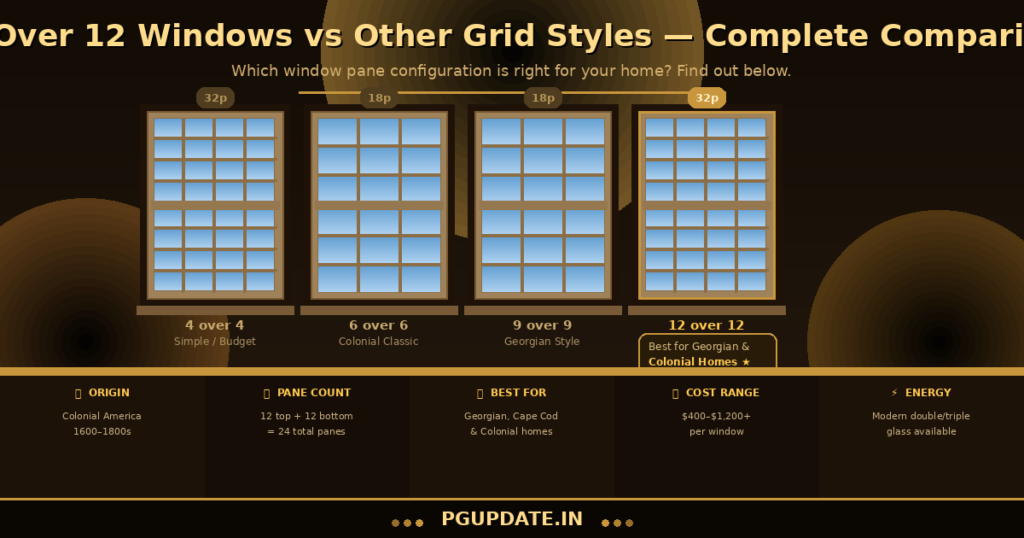
In the colonial era, 6-over-6, 9-over-9, and 12-over-12 configurations were common. The more prestigious the home, the more panes it tended to feature. A 12-over-12 window was, in many respects, a status symbol — it signalled that the owner had both the means to afford the additional glazing work and the architectural ambition to build in the Georgian grand tradition.
By the mid-1800s, improvements in glass manufacturing allowed for larger sheets to be produced affordably, and the practical need for small multi-pane windows disappeared almost overnight. The 2-over-2 and later the single-pane window became dominant. However, for those seeking to restore or replicate Georgian Colonial homes, a 9-over-9 or 12-over-12 pane configuration remains essential to capturing their symmetry and formality.
Anatomy of a 12 Over 12 Window — Every Part Explained
Before you start shopping for 12/12 windows, it pays to know the anatomy of what you’re buying. Here’s a breakdown of every key component:
Frame: The outermost structure that surrounds and supports the entire window assembly. On 12-over-12 windows designed for Colonial homes, frames are typically wider than modern slim-profile windows to maintain period-appropriate proportions.
Sash: The moving panel within the frame that holds the glass. A double-hung window has two sashes — an upper sash and a lower sash — both of which can slide vertically. In a 12/12 configuration, each sash contains 12 panes arranged in a 4×3 grid.
Muntins (Glazing Bars): The dividing strips — either structural in original windows or decorative/simulated in modern versions — that create the grid pattern across the glass. In authentic period reproductions, muntins are finely profiled wood members with an ogee or ovolo cross-section.
Check Rail: The horizontal member in the centre of the window where the upper and lower sashes meet and overlap when closed. This is where the window lock is typically located.
Sill: The horizontal member at the base of the window, which slopes outward to drain rainwater away from the building.
Jamb: The vertical side members of the window frame.
Crown / Pediment (optional): On more formal Georgian Colonial homes, windows are topped with a decorative triangular or arched pediment that dramatically enhances the visual presence of the window. If you’re installing 12-over-12 windows on a period home, adding a crown moulding above each window is highly recommended for historical accuracy.
Shutters: The choices you make for your trim and shutters can reinforce the colonial styling of your windows and your home. Flat shutters on each side of the windows complement the design. Exterior shutters — whether functional or purely decorative — are an essential companion to 12/12 windows on any Colonial-style home.
12/12 vs 9/9 vs 6/6 — Which Window Configuration Is Right for Your Home?
One of the most common questions homeowners and architects ask is: “Do I really need 12-over-12, or will 6-over-6 look just as good?” The honest answer depends on your home’s architectural style, size, and the level of historical fidelity you’re aiming for.
6 over 6 windows are by far the most popular Colonial grid configuration today. Both Colonial and Cape Cod styles often feature double hung or single hung windows with multi-pane grids in six-by-six, nine-by-nine, or 12-by-12 patterns. A 6/6 window is simpler, less expensive, easier to maintain, and still delivers strong Colonial character. It’s the best choice for modest Colonial homes, Cape Cod cottages, and farmhouse-style builds.
9 over 9 windows sit in the middle ground — more refined than 6/6, less complex than 12/12. They’re a natural fit for Dutch Colonial and Federal style homes, and are particularly well-suited to homes where the windows are of medium size and the facade calls for more visual detail than 6/6 provides but doesn’t have the grand scale to justify 12/12.
12 over 12 windows are the most formal and historically prestigious option. A Georgian Colonial home, characterised by its symmetry and formality, demands double-hung windows with a precise grid pattern, often 9-over-9 or 12-over-12. If you’re working on a large, symmetrical Georgian Colonial or a grand Federal-style property, 12/12 windows are the authentic, architecturally correct choice. The greater number of panes creates a finer visual texture that suits large window openings perfectly — a 12/12 configuration on a small window can look overcrowded and cluttered.
What Home Styles Suit 12 Over 12 Windows Best?
Not every home is a natural fit for 12-over-12 windows. Used in the wrong architectural context, they can look oddly busy or historically incongruent. Here’s where they genuinely shine:
Georgian Colonial Homes are the definitive home for 12/12 windows. Georgian Colonial houses are characterised by their symmetry and formal, classical proportions, built in a classic rectangular shape with brick or stone. Windows are typically single hung, uniformly aligned in rows across the front of the home, and have a traditional window grid pattern. The fine grid of a 12/12 window perfectly mirrors the formal, meticulous character of Georgian architecture.
Federal Style Homes — the refined American evolution of Georgian architecture — also suit 12/12 windows beautifully. Federal homes have slightly larger windows than their Georgian predecessors, making the extra pane density of a 12/12 configuration even more visually appropriate.
Colonial Revival Homes (built in the 20th century in Colonial styles) are another excellent candidate, particularly larger examples where window proportions can support the density of a 12-pane sash.
Grand Farmhouse & Cape Cod Homes can incorporate 12/12 windows on feature elevations — typically the front facade — for maximum kerb appeal, while using simpler 6/6 windows on side and rear elevations to manage cost.
On the other hand, ranch-style homes, mid-century modern houses, minimalist contemporary builds, and Craftsman bungalows are typically poor candidates for 12/12 windows. Many ranches in the Eastern part of the country have colonial-style multipane windows — elements that are more appropriate on a colonial-style house. Forcing 12/12 windows onto an incompatible architectural style creates visual dissonance that experienced designers and appraisers will immediately notice.
Are 12 Over 12 Windows Energy Efficient in 2026?
This is one of the most important practical questions for modern homeowners considering 12-over-12 windows. The short answer is: yes — absolutely, but only if you choose the right type.
Original 17th and 18th century 12/12 windows were single-glazed with hand-blown glass and wooden frames — they were energy nightmares by modern standards, responsible for enormous heat loss in winter and solar gain in summer. No homeowner in 2026 should be installing genuine single-glazed period windows unless they’re undertaking a museum-quality historic restoration with specific constraints.
Fortunately, the window industry has adapted beautifully. Energy efficiency: Instead of single-pane glass, today’s colonial windows use double- or triple-pane glass to provide excellent insulation. Improved functionality: Modern colonial-style windows can feature tilt-in sashes for easy cleaning, or between-the-glass shades that are low maintenance.
Modern 12-over-12 windows achieve their Colonial appearance through Simulated Divided Light (SDL) technology — a single large pane of double or triple-glazed insulated glass sits inside the sash, with decorative muntins applied to the interior and exterior surfaces to create the visual impression of 12 individual panes. Simulated-Divided-Light grilles are permanently bonded to the interior and exterior, creating a strikingly authentic appearance.
When shopping for energy-efficient 12/12 windows in 2026, look for these key specifications: a U-factor of 0.30 or lower (measures heat transfer), a Solar Heat Gain Coefficient (SHGC) appropriate for your climate, Low-E glass coatings to reduce UV and infrared transmission, and argon or krypton gas filling between double-pane units for enhanced thermal performance. ENERGY STAR certified 12/12 windows are available from most major manufacturers and should be your baseline requirement for any new installation.
Materials & Frame Options for 12 Over 12 Windows
The frame material you choose for your 12-over-12 windows will significantly affect their appearance, performance, maintenance requirements, and cost. Here are your main options:
Wood Frames offer the most historically authentic appearance and remain the gold standard for period-accurate Colonial restorations. High-quality wood frames — typically pine, mahogany, or Douglas fir — can be painted or stained to match any colour scheme and accept decorative moulding profiles with beautiful results. The downside is that wood requires regular maintenance (painting, sealing) and is vulnerable to rot and insect damage if neglected.
Fibreglass Frames have emerged as the premium choice for modern 12/12 window installations. Fibreglass can be manufactured to closely mimic the appearance of painted wood, accepts paint permanently, is dimensionally stable (it doesn’t expand and contract with temperature changes the way wood does), and is virtually maintenance-free. For Colonial homes where wood-like appearance is essential but low maintenance is also a priority, fibreglass is difficult to beat.
Aluminium-Clad Wood Frames offer the best of both worlds for exterior durability — a wood interior for visual warmth and ease of customisation, protected by a low-maintenance aluminium exterior cladding. Many premium window manufacturers offer their 12/12 Colonial configurations in this format.
Vinyl Frames are the budget-friendly option. While vinyl 12/12 windows are available and perform well thermally, vinyl profiles tend to look slightly heavier and less refined than wood or fibreglass, which can compromise the elegance of a period Colonial design. They’re an acceptable choice for Colonial-inspired new construction where strict historical accuracy is not the primary goal.
12 Over 12 Window Cost Breakdown — What to Expect in 2026
One of the most searched questions around 12-over-12 windows is cost, and for good reason — these are not budget windows. Their complexity, the precision muntin work required, and their niche market position all contribute to a premium price point. Here’s a realistic breakdown:
Supply cost per window unit ranges from approximately $400 to $1,200+ depending on size, frame material, glazing specification, and manufacturer. Budget vinyl 12/12 windows from mid-range suppliers start around $400–$600. Premium fibreglass or wood units from specialist Colonial window manufacturers — brands like Pella, Andersen, Marvin, and Sierra Pacific — typically range from $700 to $1,200+ per unit, before installation.
Installation cost adds $150–$400 per window on top of the unit price, depending on your location, the complexity of the installation (new construction vs. replacement), and whether any structural modifications to the window opening are required.
Total installed cost for a typical 12/12 Colonial window therefore runs $550 to $1,600+ per window. For a home with 20 windows, this represents a total investment of $11,000 to $32,000 — a significant but often worthwhile investment given the kerb appeal, historical authenticity, and potential property value uplift that authentic Colonial windows provide.
For budget-conscious projects, consider using 12/12 windows only on the primary front facade — the elevation visible from the street — and using 6/6 windows on less prominent side and rear elevations. This hybrid approach can significantly reduce total cost while still achieving a visually stunning Colonial exterior presentation.
Installation Guide: What to Know Before You Buy
Installing 12-over-12 windows — whether as a new construction feature or as replacements for existing windows — requires careful planning. Here’s what every homeowner needs to understand before proceeding:
Rough Opening Sizing: Always order your windows after confirming your rough opening dimensions. Standard rough opening sizing for window replacements follows industry conventions, but Colonial-style 12/12 windows often have specific proportional requirements. A window that’s too wide or too squat will look wrong regardless of how good the muntins are. Consult your architect or a specialist Colonial window dealer for guidance on proportions appropriate to your home.
New Construction vs Replacement: For new construction, windows are installed with a nailing fin before exterior cladding is applied. Replacement windows typically use a block frame system inserted into the existing opening. Both methods work well for 12/12 windows, but replacement installations require careful assessment of the existing frame condition.
Structural Considerations: Window openings require proper headers above them to transfer structural loads around the opening. In older Colonial homes, check the condition of existing headers before replacing windows — this is especially important if you’re changing the size of any openings.
Local Building Codes: Building permits are typically required for window replacement projects. Requirements vary by municipality, but most jurisdictions require that replacement windows meet current energy code minimum standards. Verify that your chosen 12/12 windows meet the energy performance requirements for your climate zone.
Historic District Considerations: If your home is located in a designated historic district, window replacement may be subject to approval by a historic preservation commission. In many cases, this works in favour of 12/12 window installations — authentic Colonial grid patterns are typically preferred by preservation bodies over modern clear-pane alternatives. Always check with your local planning office before ordering.
Maintenance Tips for 12 Over 12 Windows
Owning beautiful 12-over-12 windows means committing to some level of regular maintenance to keep them looking and performing at their best. The specific requirements vary by frame material, but here are universal best practices:
Cleaning the glass: The multiple panes created by muntin grids mean more edges and corners to clean. Use a good quality glass cleaner and a fine-edged squeegee or microfibre cloth. For Simulated Divided Light windows with between-the-glass muntins, the glass surfaces are smooth and clean quickly. For windows with surface-applied grilles, clean around the muntin edges carefully with a soft brush or cotton swab.
Wood frame maintenance: If you have wood-framed 12/12 windows, inspect all exterior surfaces annually for paint failure, cracking, or signs of moisture penetration. Repaint or re-stain any degraded areas promptly. Never let bare wood remain exposed to the elements. Check glazing putty (on true divided-light windows) and replace any that has cracked or fallen out.
Hardware inspection: Double-hung windows rely on a balance mechanism (historically sash weights, now typically spring balances or spiral balances) to hold the sash in position when raised. Test your window balances annually and replace any that are weak or broken — a sash that drops unexpectedly is both a safety hazard and an energy efficiency issue.
Weatherstripping: Inspect weatherstripping around both sashes every 2–3 years and replace it when it becomes compressed, cracked, or loses its sealing effectiveness. Proper weatherstripping is critical to the energy performance of any window, but especially important for 12/12 windows where multiple sashes must seal tightly.
Where to Buy 12 Over 12 Windows in 2026
Finding genuine, high-quality 12-over-12 windows requires sourcing from manufacturers who specialise in Colonial and traditional architectural styles. Here are the most respected suppliers:
Pella Windows & Doors offers a comprehensive range of Colonial-style windows including 12/12 configurations in wood, fibreglass, and aluminium-clad wood. Their Colonial Windows Guide is an excellent starting resource.
Andersen Windows is one of America’s most established window manufacturers with strong Colonial offerings. Their Andersen Windows website includes a detailed window configurator.
Marvin Windows specialises in premium custom wood and fibreglass windows and is particularly well-regarded in the historic restoration community for accurate period reproductions including 12/12 configurations. Visit Marvin.com for their full range.
Harvey Building Products offers Colonial grid options including SDL configurations. Their Harvey Window Grids Guide is a helpful visual reference.
MI Windows and Doors covers a wide range of architectural styles including Colonial. Their architectural styles guide helps you match window types to home styles.
For local sourcing in India, established window manufacturers like Saint-Gobain, Fenesta, and AIS Windows offer custom grid configurations that can approximate 12/12 Colonial styles for architectural and heritage projects.
Frequently Asked Questions — 12 Over 12 Windows
What does “12 over 12” mean in windows?
“12 over 12” describes the pane configuration of a double-hung window: 12 individual glass panes in the upper sash positioned above 12 panes in the lower sash, for a total of 24 panes. The panes are typically arranged in a 4-column by 3-row grid in each sash.
Are 12 over 12 windows only for Colonial homes?
They’re most historically appropriate for Georgian Colonial, Federal, and Colonial Revival homes, but they can be used on any traditional or classical-style architecture where a formal, symmetrical window grid suits the design. They’re generally not recommended for modern, minimalist, or ranch-style homes.
How many panes does a 12 over 12 window have?
A 12-over-12 window has 24 individual pane divisions in total — 12 in the upper sash and 12 in the lower sash. In modern Simulated Divided Light windows, the actual glass is typically one large insulated unit per sash, with decorative muntins creating the visual impression of 12 separate panes.
Are 12 over 12 windows more expensive than 6 over 6?
Yes, generally. The additional muntin work, greater precision required in manufacturing, and the niche specialist market for 12/12 windows typically means they cost 20–40% more than equivalent 6-over-6 units from the same manufacturer.
Can I get energy-efficient 12 over 12 windows?
Absolutely. Modern 12/12 windows are available with double or triple-pane insulated glass, Low-E coatings, argon gas filling, and ENERGY STAR certification. The decorative muntins are applied over the insulated glass unit, so they have no negative effect on thermal performance.
What colour should 12 over 12 windows be painted?
White and off-white are the most historically authentic choices for Colonial-style 12/12 windows. The most popular colours for colonial-style windows are white, off-white, black, and muted earth tones, like soft grays and browns. Black frames have also grown significantly in popularity for a bold, modern-traditional look.
Do I need planning permission to install 12 over 12 windows?
In most jurisdictions, window replacements of the same approximate size require a building permit but not full planning permission. If your home is in a historic preservation district, additional approval may be required — but 12/12 Colonial configurations are typically favoured by preservation authorities.
Final Verdict — Are 12 Over 12 Windows Worth It?
After three centuries, 12 over 12 windows remain one of the most visually powerful statements in residential architecture. They are not the most practical or budget-friendly window choice available — but they were never meant to be. They are an architectural declaration: a commitment to historical authenticity, fine craft, formal proportion, and enduring elegance.
If you own a Georgian Colonial home, a Federal-style property, or a grand Colonial Revival and you want it to look exactly as it should — precisely, beautifully, authentically — then 12-over-12 windows are not just a good choice. They are the correct choice. Pair them with proper shutters, appropriate crown moulding, and a historically informed colour palette, and the result is a facade that commands genuine admiration.
If budget is a concern, consider a strategic deployment: 12/12 on the primary front facade, 6/6 elsewhere. If performance is your priority, specify modern fibreglass frames with double-pane SDL glass and Low-E coatings. The technology exists to give you both the beauty of 1780 and the performance of 2026 — and that is a remarkable thing.
Have questions about your specific project? Drop them in the comments below — we’re happy to help you navigate the world of Colonial window architecture.
📌 More Guides You’ll Find Useful at PG Update
- How to Install Windows on Chromebook – Complete 2026 Guide
- Microsoft Update Catalog: The Complete 2026 Guide for IT Professionals
- Windows Update Stuck on Pending Download? Here’s How to Fix It
- How to Run GPUpdate: Refreshing Group Policy Settings
- How to Get Custom Skin Packs for Windows 11
Tags: 12 over 12 windows · 12/12 window configuration · colonial double hung windows · 12 pane window grids · Georgian window style · window pane configurations · 12 over 12 windows cost · colonial window muntins · double hung colonial windows · window grid patterns · 12 lite window · 6 over 6 vs 12 over 12 windows · historic window restoration